Affiliate disclosure: As an Amazon Associate, Pro Golf Insights earns from qualifying purchases. We may also earn a commission from other affiliate links, at no extra cost to you.
Putter forgiveness is worth checking when ordinary misses leave you with difficult next putts. Before buying, compare where your putts finish and, when a fitter can identify it, where the ball met the face. A large head or a technology name is a reason to investigate, not proof of better distance control for your stroke.
This guide is for golfers, including higher handicappers, who want to assess off-centre performance without choosing a putter from handicap alone. It is research-based buying advice and our suggested comparison routine, not a hands-on putter test. Primary manufacturer information was checked on 17 October 2026.
The quick buying check
- Compare your current putter with a candidate using the same ball type and a comparable putting line.
- Record a group of normal putts, including ordinary misses, rather than remembering only the best result.
- Separate stopping-distance patterns from start direction, and identify impact location before calling a strike off-centre.
- Repeat the comparison from another distance and discuss the pattern with a fitter.
- Confirm the exact head, neck, length, lie, loft and grip before placing an order.
What does putter forgiveness mean?
Ask what a particular claim is about. Resistance to twisting, ball-speed consistency across the face and the stopping positions you produce are related questions, but they are not the same measurement. A specification answering one question does not supply your result for the others.
In Scotty Cameron’s interview with putter designer Austie Rollinson, MOI, or moment of inertia, is described as resistance to twisting on off-centre hits. The discussion also considers centre-of-gravity depth, rather than treating a high MOI number as the entire design decision.
For a separate face-design example, the technology section on Cleveland’s HB SOFT 2 Model 15 page describes changing groove spacing from the centre toward the heel and toe to normalise ball speed. It says the milling patterns account for individual models’ centre of gravity and MOI. Those are the manufacturer’s design descriptions, not results from our own comparison or a guarantee that every mishit finishes the same distance.
These examples explain why “forgiving” needs context. Neither establishes a universal best putter for a handicap, a percentage reduction in your misses or a promised number of putts saved. Check the claim for the exact model and generation you are considering.
Confirm impact location before blaming an off-centre strike
A putt stopping short does not tell you where impact occurred. If impact location is important to the comparison, ask whether the fitter can identify it reliably with suitable equipment or an appropriate observation method. Label a strike centre, heel or toe only when that information is available; otherwise write “impact unknown”.
Do not treat the sound alone as proof of impact position or change your normal stroke just to create a miss. A fitter can decide whether a separate controlled impact comparison would help. Keep those deliberately produced strikes separate from the normal putts you use to assess the whole setup.
Record any feedback system or method used. Do not apply tape, sprays or another material to a shop putter’s face without permission and an explanation of whether it would change the comparison. If the setup cannot identify impact, you can still compare your overall stopping pattern honestly without claiming to have isolated off-centre performance.
A suggested comparison before you buy
The following is our practical comparison routine. It is not a laboratory test, a statistical proof of head performance or a fixed minimum sample for a fitting.
- Start with your current putter. Describe the problem you regularly face, such as inconsistent finishing distance. Bring the club you actually use, including its current grip.
- Keep the task comparable. Use the same ball type, starting area and intended target where practical. Note the surface and line. If one putter is tried on a different slope or surface, do not treat the groups as directly equivalent.
- Hit a group of ordinary putts. Give each putter a fair opportunity, with familiarisation before recording the comparison. Keep ordinary misses in the notes. Alternating comparable groups can help you notice when learning or fatigue changes the session.
- Record two outcomes separately. Note whether a putt finishes short or long of your intended distance and where it finishes sideways. Record the chosen target and start-line observations separately when those can be assessed.
- Add impact information when available. Ask the fitter to compare confirmed centre, heel and toe strikes within the record. Do not quietly replace unknown impacts with guessed labels.
- Repeat at another distance. Include a longer putt relevant to your rounds as well as a shorter task. A successful short demonstration does not settle longer-distance pace control. Repeat a promising result in another group or session.
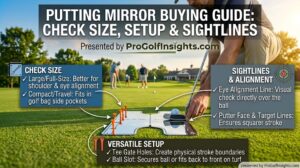
If practising at home, keep the limitations visible. A short mat offers a different task from a longer putt on a green. Our putting mat buying guide explains space and usable roll-length checks. Use the same available area for both putters, and do not convert an indoor result into a universal on-course claim.
Watch our putter comparison Short.
Watch our putter comparison Short.
Watch our putter comparison Short.
How to read the pattern without overstating it
| What you observe | Useful next question | What not to assume |
|---|---|---|
| Confirmed heel or toe strikes finish differently from centre strikes. | Does the pattern repeat with comparable tasks and the candidate? | That one human trial isolates every equipment variable. |
| Distance varies but impact location is unknown. | Can the fitter identify impact and check the rest of the delivery? | That every short putt was an off-centre strike. |
| A candidate helps one task but feels harder to aim. | How does the complete fitted setup perform across your normal tasks? | That one distance result settles the purchase. |
| A larger head produces no useful improvement in your trial. | Is another build worth trying, or does your current putter suit you? | That you must replace it because a category is marketed as forgiving. |
Look at the whole group and its spread, not just one holed putt or one poor strike. A result from your own trial is evidence about that session and setup. It is not a ranking of every putter or proof that another golfer will obtain the same benefit.
A human comparison also includes differences in aim, stroke, strike and adaptation to each club. Ask a fitter or coach to help interpret an unclear pattern before paying for a change. You do not need a new putter merely because a demonstration supplied more technical numbers.
Buy the exact configuration you compared
For general posture, length, alignment and grip considerations, start with our beginner putter fitting guide. Here, the additional question is whether the candidate’s ordinary misses and confirmed impact patterns make a useful difference for you.
Write down the head model and generation, neck or shaft arrangement, handedness, playing length, fitted lie and loft, grip and any weighting configuration. A familiar family name does not establish that an online listing is the same club you tried.
Check the seller’s actual specification, delivered cost in your currency, local support and return conditions. For a used putter, ask about changes to length, grip, loft, lie or weights, and inspect the face and condition. Do not assume it still matches a stock catalogue build.
You can include a mallet in the shortlist without declaring every larger head the winner. Keep an existing putter that performs satisfactorily, and choose a replacement for a repeatable, relevant benefit in its complete fitted setup.
Compare mallet putters that suit your fitted setup.
Compare mallet putters that suit your fitted setup.
Compare mallet putters that suit your fitted setup.
Common questions
Does high MOI guarantee good distance control?
No. It describes resistance to twisting, while your finishing pattern also involves the complete putter, delivery, task and surface. Compare the results you can produce rather than treating the specification as a guarantee.
Is every mallet better for a high handicapper?
Do not choose from handicap or outline alone. Use those features to make a shortlist, then assess the exact build with your normal stroke and the shots you face.
Can I compare putters without impact-tracking equipment?
Yes, you can compare overall stopping patterns and usability. Keep impact location marked unknown unless it can be identified; that prevents an ordinary comparison from being presented as an isolated test of off-centre hits.
Sources
- Scotty Cameron: Austie Rollinson, Senior Director Putter R&D — MOI, off-centre twisting and design context.
- Cleveland Golf: HB SOFT 2 Model 15 — attributed face-groove and ball-speed design example, not our measured result.
Watch The Youtube Video
The companion Short explains how to compare ordinary misses, keep impact labels honest and check the exact putter build before buying.