Driver playing length is a detail to confirm for the complete club you are buying. A head model, shaft name or “standard length” label does not, by itself, tell you the length of every available build or establish which one suits your swing.
Before choosing a stock driver, ordering a custom build or buying a replacement shaft, establish the finished club specification and compare suitable options. The useful question is whether that particular build gives you repeatable, usable tee shots.
This is research-based buying guidance, not our hands-on driver test or an individual fitting prescription. Primary manufacturer sources were checked on 27 October 2026. The comparison routine and buying checklist below are editorial advice.
Affiliate disclosure: As an Amazon Associate, Pro Golf Insights earns from qualifying purchases, at no extra cost to you. The marked placeholders below are for the owner to replace with approved affiliate URLs or remove before publication.
Confirm which length the seller is quoting
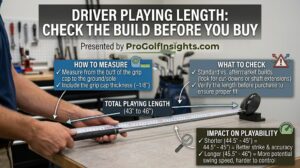
Ask for the playing length of the assembled driver, with the specified head, shaft, adapter and grip. Keep that answer with the order specification. If you are looking at a loose shaft, establish whether its quoted length describes a raw component or a prepared assembly; do not treat it as a confirmed finished driver length.
Ask how the seller or fitter measures the club and use a consistent method when comparing builds. Do not add a guessed allowance to a loose-shaft measurement. If two descriptions appear to disagree, have the seller clarify the finished specification rather than trying to reconcile them from photographs.
| Listing wording | Question to ask |
|---|---|
| “Standard length” | Standard for which exact model, shaft option and build? |
| “Shorter than standard” | What is the actual finished playing length, and which baseline is being used? |
| A shaft length without a head | What component or assembly was measured, and what finished length will it produce in the intended driver? |
| Custom or previously altered club | What is its current measured build, and what alterations are known? |
Read the notes beneath a stock specification
A manufacturer’s specification is a reference for the stated configuration. It is not a universal driver length or a recommendation for every golfer.
For a concrete example, PING’s current US G440 MAX driver specifications list 46 inches with the ALTA CB Blue 50. The same page lists 45½ inches with PING Tour 2.0 Chrome or Black, Mitsubishi Tensei 1K and Project X Denali Red shafts. PING identifies these as design specifications subject to manufacturing tolerances.
The lesson is to read the shaft and build notes as well as the headline number. This example is specific to that published US configuration; check the current specification and available options in your market. It is not a review, an independent measurement or a claim that either length will perform better for you.
Use your current driver as a comparison point
Bring your current driver and describe what you want to improve. Is your concern the spread of your usual shots, inconsistent contact, carry distance or how the club feels to swing? Agree on the question before comparing alternatives.
Titleist’s fitting guidance describes establishing baseline data with a player’s current clubs, using launch-monitor information and player feedback, then evaluating combinations that include head, shaft, weight, lie and length. That supports assessing the whole build rather than choosing from one dimension alone.
Tell the fitter that you want to evaluate playing length, and ask which comparison builds are available. If other specifications change at the same time, record those changes. An improvement with a different head and shaft as well as a different length cannot be attributed to length alone.
Compare the shot pattern, not only the longest drive
Use a simple comparison record during an appropriate fitting or supervised demo. Keep the target and ball choice consistent where practical, warm up and compare a series of representative swings. Ask the fitter how many shots are needed for a useful comparison and when to pause if fatigue changes your swing.
- Contact: record the strike information available during the session and whether the pattern repeats.
- Carry: compare the ordinary carry results and their variation, not just one exceptional shot.
- Direction: look at the left-to-right spread and the misses that matter for the courses you play.
- Confidence and feel: note whether you can make your normal swing comfortably and repeat it.
- Build: record the actual playing length and the other specifications used for each comparison.
This is a suggested evaluation routine, not a test we have performed. Do not assume a shorter build must be straighter or a longer one must produce more usable distance. Use the results of your own comparison to decide whether a change is worthwhile.
If no suitable length comparison is available, do not fill the gap with a height-only chart or a recommendation based on someone else’s driver. Ask about another fitting opportunity or an appropriate trial arrangement.
Agree on the complete build before ordering or altering
Ask the fitter or builder to write down the selected head and loft, shaft model and flex, finished playing length, grip and any other agreed build details. Confirm that the driver being ordered matches the one you assessed, or clarify any differences before paying.
For a replacement shaft, confirm the intended head, compatible adapter and resulting assembled length with the seller or builder. Our adjustable driver hosel guide covers the separate questions of settings and compatibility. An adapter fitting a head is not evidence that the finished club has the playing length you want.
If you are considering changing your existing club, have a qualified club professional assess the complete build first. This guide does not give a cutting, extension or reweighting procedure. Ask what work is proposed, how the resulting club will be checked and whether the change affects the seller’s trial or return terms.
Check the purchase terms for your actual order
Confirm local availability, total delivered cost and applicable fitting or build charges. For a custom order or altered club, read the exact cancellation, trial, return and warranty terms before committing. Do not assume another seller, market or stock purchase offers the same terms.
Compare golf drivers after confirming the exact build and playing length.
Compare golf drivers after confirming the exact build and playing length.
Compare golf drivers after confirming the exact build and playing length.
These are shopping options for the owner’s review, not a recommendation to buy an unverified component or to modify a club yourself. No prices, ratings or performance gains are claimed.
Common questions
Is there one standard driver playing length?
Check the exact model and configuration. The PING example above shows why shaft-option notes can change the published stock figure even within one driver model.
Can I choose a length from my height alone?
Use an individual fitting and a comparison with your current club to evaluate the complete build. This guide supplies no height-to-length prescription.
Should I buy a shorter driver to improve accuracy?
Compare a suitable alternative before buying or altering a club. Evaluate your usual contact, carry, direction and comfort together; this article establishes no universal winning length.
Sources
Primary sources checked on 27 October 2026. These support the stock-build example and fitting-process summary; the seller questions and comparison checklist are editorial guidance.
- PING: G440 MAX Driver, US specifications and configuration notes.
- Titleist: Golf Club Fitting, baseline and fitting-process guidance.
Watch The Youtube Video
The companion Short explains why a driver listing’s length needs a complete-club check and what to compare before buying. The owner will add the public video here after reviewing and uploading it.