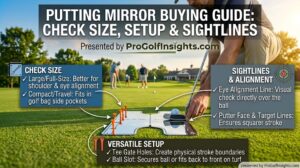
A putting mirror buying guide should start with one question: what do you want to see? A small mirror that travels easily may show your eyes and putter face without showing your shoulders. A larger model or a compatible shoulder accessory may suit a different practice routine.
Choose the view, practice surface and accessories together. A useful mirror is one you can set up consistently with your own putter, ball and available space; a long list of drills is less useful if the basic setup does not fit.
Research note: This guide uses current manufacturer product information checked on 30 October 2026 and practical buying considerations. We have not conducted hands-on mirror comparisons or measured putting improvements.
Affiliate disclosure: As an Amazon Associate, Pro Golf Insights earns from qualifying purchases. The editorial placeholders below are for the owner to replace with approved affiliate URLs or remove before publication.
Choose the view before the size label
Decide whether you want a quick address-position check, a view of your shoulders, or a mirror used with a separate gate. These requirements can lead to different purchases.
| Your main need | What to confirm before buying |
|---|---|
| A portable warm-up aid | The selected mirror provides the view you need and fits its case and your bag pocket. |
| Shoulder visibility | The exact model shows your shoulders from your normal address position, or supports a named shoulder accessory. |
| Indoor gate practice | The posts, guides or freestanding gate are suitable for your surface and compatible with that mirror. |
| A simple repeatable routine | The markings are easy to interpret and the device sits securely in your actual practice space. |
For a model-specific example, EyeLine’s current mirror FAQ says its small Putting Alignment Mirror does not show the shoulders. It identifies a separate shoulder mirror as an option and points to its larger Classic and Groove PLUS mirrors for a wider view. Check the selected product, rather than assuming every mirror in a manufacturer’s range shows the same area. See the EyeLine mirror FAQ.
Compare putting mirrors with the view you need on Amazon!
Compare putting mirrors with the view you need on Amazon!
Compare putting mirrors with the view you need on Amazon!
Check the usable view and the packed footprint
Overall dimensions tell you how much space an item occupies. They do not fully describe the part of your setup visible in its reflective area. Ask for an address-position demonstration of the selected model, especially when shoulder visibility is the reason for buying.
Check both the mirror’s dimensions and its packed dimensions with the case and accessories. For bag storage, measure the usable pocket opening as well as the pocket interior. A long narrow opening can be the limiting part, even if the pocket looks spacious.
When dimensions are supplied in unfamiliar units, convert them before ordering. A paper outline can help you judge the footprint on your mat and in your bag, but it cannot reproduce the mirror’s actual view. Do not mix dimensions from a compact version, a larger version and a similarly named bundle.
Match the base and accessories to your practice surface
Check where the mirror will sit: a practice green, an indoor putting mat or another surface approved by the manufacturer. Confirm that the complete base sits flat, does not rock and leaves enough room for your normal stance and stroke. Look at the ball’s route off the mirror and any raised edges before treating the whole setup as ready for practice.
Outdoor tee holes do not automatically provide an indoor solution. EyeLine describes tees for outdoor gate practice and indoor posts for indoor use. Its separate Indoor Putting Gate Posts page names compatible aids and explicitly excludes the Edge Putting Mirror. An accessory from the same brand is still worth checking by exact model.
For indoor use, confirm the manufacturer’s supported method rather than pushing tees or a spiked base into flooring or an unsuitable mat. On a club’s practice green, follow its rules for training aids. Secure parts only as directed for that model and surface.
If a mat is part of the purchase, allow for the entire arrangement, including your feet, target and any separate gate. Our published putting mat buying guide explains how overall mat length differs from usable putting distance and why stance space matters.
Separate a putter gate from a ball gate
A gate around the putter head and a gate farther along the ball’s path answer different practice questions. Check the product instructions and photographs to identify which parts are included and what each part is intended to do.
Before buying a putter gate or guides, check whether their supported spacing accommodates your putter head and the intended drill. For a separate ball gate, check the required placement and available roll space. A kit photographed with multiple accessories may be sold in several configurations.
The mirror’s printed lines provide a reference. They do not choose the correct start direction for a breaking putt or measure every part of a moving stroke. Avoid treating a tidy reflection or a successful gate attempt as proof that a particular putter is the right fit.
Compare the actual bundle contents
Make a short parts list for the exact listing you plan to order: mirror, protective case, shoulder attachment if needed, indoor posts or magnetic guides, separate gate, and any supporting feet. Mark each item as included, optional or incompatible.
For example, PuttOUT’s current Mirror & Adjustable Gate Set lists a mirror with protective rubber casing, a gate frame, hanging gate pieces, weighted rubber feet, magnetic stroke-path guides and a carry case. That is a description of the named current set, not a promise about every PuttOUT mirror listing or an older bundle. Check your local seller’s actual contents.
Compare the complete delivered purchase in your own market, including any necessary accessories, shipping, applicable taxes and return conditions. Confirm who handles a missing part or a mirror that arrives damaged. A local listing with clear support may be more practical than importing a kit whose accessories are difficult to replace.
Compare putting-mirror sets with compatible indoor accessories on Amazon!
Compare putting-mirror sets with compatible indoor accessories on Amazon!
Compare putting-mirror sets with compatible indoor accessories on Amazon!
Use a simple trial before keeping the mirror
- Read the selected model’s instructions. Identify its reference lines, supported surfaces and accessory positions.
- Check the complete setup. Use your normal putter, ball, footwear and practice area. Confirm that you can stand comfortably and see the intended reflection.
- Choose a start direction first. Position the aid according to its instructions; the mirror is a reference for your chosen setup, not a green-reading device.
- Check one feature at a time. Begin with the view you bought it for, then add supported guides or gates. Leave the putter enough room for the instructed drill.
- Repeat without the aid. Notice whether the routine is understandable and easy to reproduce. Discuss changes to eye position, posture or stroke with an instructor who can assess your own setup.
Do not force an uncomfortable posture just to make your reflection match a generic photograph. If the view you need is absent, a different mirror or a confirmed compatible attachment is a more useful buying question than adding unrelated accessories.
Which putting mirror should you buy?
For a brief warm-up, start with a portable model that shows the specific reference you want to check and fits your bag. For shoulder visibility at home, confirm a wider usable view or an appropriate shoulder attachment. For indoor gate practice, make compatibility and surface support part of the initial purchase.
Choose the simplest complete setup that meets those needs. Manufacturer demonstrations explain intended use; they are not independent proof of a score improvement. A mirror can support a practice routine, but it does not replace a putter fitting, instruction or practice on real greens.
Sources
- EyeLine Golf Putting Mirrors – selected-model views, shoulder options and outdoor/indoor gate guidance.
- EyeLine Indoor Putting Gate Posts – named compatibility and Edge mirror exclusion.
- PuttOUT Mirror & Adjustable Gate Set – contents of the current named set and intended practice surfaces.
Manufacturer pages checked on 30 October 2026. Availability, bundles and policies can vary by country and may change; verify the selected local listing before buying.
Watch The Youtube Video
The companion Short will explain how to choose a putting mirror by the view you need and the accessories your practice surface supports. The owner will add the reviewed public video here after uploading it.