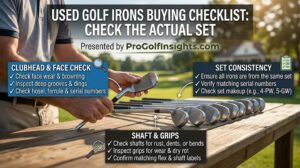
A used golf irons buying checklist should help you identify the actual clubs being offered, their current build and condition, and the terms that apply to the purchase. A familiar model name and an appealing photograph are only the start of that check.
Before paying, make a club-by-club record of the set, clarify any important unknowns with the seller and decide whether the resulting offer suits your needs. This guide focuses on verifying a particular used listing, rather than choosing how many irons belong in your bag.
This is research-based buying guidance, not our hands-on inspection, authenticity certification or performance test of a used set. Primary manufacturer and manufacturer-owned retailer sources were checked on 25 October 2026. The checklist and seller questions are editorial advice.
Affiliate disclosure: As an Amazon Associate, Pro Golf Insights earns from qualifying purchases, at no extra cost to you. The marked editorial placeholders below must be replaced with the owner’s approved affiliate URLs or removed before publication.
Write down every club included in the offer
Ask the seller to name each included iron or wedge. Record the head model and generation, handedness and shaft for each club, rather than relying on a headline such as “iron set”. Resolve any difference between the written list, photographs and selected buying option.
For a blended set, record where the head model changes. A deliberate blend can be a sensible choice, but first establish exactly what is being sold. Do the same for an individual replacement iron: check its generation and build against the clubs you already own.
| Check for each club | Information to request |
|---|---|
| Head | Club number, exact model and generation, and handedness. |
| Shaft | Manufacturer, model, labelled flex and any known replacement history. |
| Build | Current playing length and any known loft, lie or other alterations. |
| Grip | Model or description, size if known and current condition. |
| Condition | Relevant photographs, disclosed damage or repairs and the seller’s written grade definition. |
Mark an unanswered item as unknown. A seller not having a measurement is different from confirming the club is standard. Use our golf iron set makeup guide if you also need to decide whether the included clubs fill useful roles in your bag.
Find out what the photographs actually show
Check whether the images show the specific clubs you will receive or illustrate the model. For example, the Callaway Golf Pre-Owned Edge Irons listing states that its images represent the model and may not reflect the exact club purchased. That is a reason to read the image qualification, not to assume every retailer uses actual-item photographs.
Where possible, request clear photographs of the actual heads, faces, soles, shafts and grips. Include the labels and the entire set together so you can relate the details to the written club list. Ask about areas that are unclear rather than deciding their condition from an indistinct image.
A photograph can help identify an inconsistency to investigate. It cannot independently measure loft, lie or playing length, establish hidden condition or certify authenticity. If a crucial detail cannot be clarified remotely, consider an in-person inspection or an offer with more suitable inspection and return terms.
Compare the current build with the correct reference
Use the manufacturer’s specifications for the exact model and generation as a reference. Titleist’s club specifications page, for example, separates model specifications and lists loft, lie and length information. A current model’s table should not be substituted for an older generation simply because a name looks familiar.
A factory reference describes the published specification; it does not prove that a particular used club still matches it. Ask whether the set has been shortened, extended, reshafted, regripped or otherwise altered, and which details have actually been measured.
If the listing says “standard”, ask which model’s standard it refers to and how the seller established it. If it uses an adjustment description, ask what baseline the adjustment is relative to. Have an appropriately equipped fitter or club professional assess important measurements when necessary. This article does not provide a bending or repair procedure, or establish that a particular head can be adjusted to your needs.
Matching labels across the set are useful details to record, but do not turn them into a fit guarantee. Consider the actual build you need and, where possible, try a suitable comparison before committing to the purchase.
Read the seller’s condition definitions
Use the grading guide that applies to the actual seller and offer. Ask what the stated grade allows on the faces, soles, finish, shafts and grips. Keep a copy of that definition and the listing with your purchase records.
Distinguish a cosmetic description from an assessment of a concern that could need repair or replacement. Ask about disclosed damage, repairs, loose components or other uncertainty. A condition adjective alone does not resolve those questions. This guide assigns no grades, estimates no remaining club life and claims no performance advantage from an inspected set.
If you expect to replace grips or have the build checked, obtain a local estimate first and include it in your comparison. Avoid treating a low listing price as a complete cost before accounting for the work you actually need.
Check the applicable return process before paying
Read the seller’s current terms for the exact purchase, destination and condition. Callaway Golf Pre-Owned publishes a return policy; use it as an example of information to read directly rather than carrying a remembered headline into a different offer.
Ask these questions and keep the answers with the order:
- What is the deadline, and from which event is it counted?
- What condition must the clubs remain in, and is hitting or altering them allowed before a return?
- Must the complete set be returned together?
- Who pays return shipping, and what charges or deductions may apply?
- What form does the refund or credit take, and what process applies if the delivered set differs from the listing?
Do not assume another seller or country offers the same process. Confirm applicable delivery charges, import costs where relevant, warranty support and any proposed replacement work before deciding whether the whole offer fits your budget. No prices or universal return periods are claimed here.
Use the checklist to make a buying decision
| What you establish | Next step to consider |
|---|---|
| The included clubs, current build, condition information and terms are clear. | Compare that specific offer with your requirements and complete cost. |
| A measurement or build detail important to fit is unknown. | Request clarification or a suitable professional check before paying. |
| The photographs or club list conflict with the selected option. | Ask the seller to identify and confirm the actual offer. |
| A concern remains unresolved and the inspection or return terms do not suit you. | Pause the purchase and consider another offer. |
These are editorial decision prompts, not results of testing a seller or set. A complete description can help you assess an offer; it does not promise that the clubs will improve your scores.
Compare used golf iron sets after checking the actual listing and seller terms.
Compare used golf iron sets after checking the actual listing and seller terms.
Compare used golf iron sets after checking the actual listing and seller terms.
Compare golf iron grips after confirming the size and installation needs of your set.
Compare golf iron grips after confirming the size and installation needs of your set.
Compare golf iron grips after confirming the size and installation needs of your set.
Use the second shopping link only if grip replacement is part of your plan. Confirm suitability and obtain an installation estimate; a grip purchase does not resolve an uncertain head, shaft or build.
Common questions
Does the model photograph show the set I will receive?
Check the listing’s image qualification and ask the seller. Where available, use actual-item photographs alongside the selected club list and condition information.
Does a manufacturer’s specification page confirm a used set is standard?
It gives a reference for the relevant model. Confirm the offered clubs’ current build and alteration history separately; obtain measurements when important details remain uncertain.
Is a used set automatically better value than a new set?
Compare offers that meet your needs, including delivery, necessary work and the applicable inspection and return terms. This checklist does not establish a universal value winner.
Sources
Primary sources checked on 25 October 2026. These support the specification-reference and listing-policy examples; the offer-checking routine is editorial guidance.
- Titleist: Custom Components and Specifications — reference specifications for the matching model.
- Callaway Golf Pre-Owned: Edge Irons (2024) — model-image qualification.
- Callaway Golf Pre-Owned: Return Policy — consult the current terms for the relevant offer.
Watch The Youtube Video
The companion Short will summarise how to check the actual clubs, current build, condition information and seller terms in a used-iron offer. The owner will add the public video here after reviewing and uploading it.