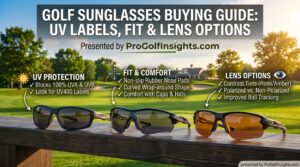
This golf sunglasses buying guide uses a simple order: verify the UV claim on the exact pair, try the frame in your golf posture, then choose the lens option and check prescription and return terms. A dark lens or a golf label is not enough information to make the purchase.
Start with the conditions you play in and any eyewear you already use. A frame that looks good in a product photograph may feel different with your cap or when you look down at the ball. Try those situations before committing to a particular model.
This is research-based buying advice, with official guidance and manufacturer information checked on 11 October 2026. We have not tested these glasses on the course, measured their UV filtering, or compared green-reading performance. The product example explains listing details, rather than ranking the best sunglasses.
Affiliate disclosure: As an Amazon Associate, Pro Golf Insights earns from qualifying purchases, at no extra cost to you.
Check the UV label before choosing the tint
The FDA’s sunglasses guidance recommends looking for a UV400 rating or “100% UV protection” on the label. It also explains that lens darkness does not establish UV protection. Read the documentation for the exact lens supplied, rather than treating its colour or price as proof.
If the listing gives only a tint name, ask for its UV specification before buying. For eyewear you already own with unclear documentation, the FDA notes that an eye care professional may be able to check its UV protection. We cannot verify that protection from a product photograph.
Separate UV protection, tint and polarization
These are different questions to ask about a lens. National Eye Institute guidance discusses clearly labelled UV protection and notes that polarized lenses can reduce glare from reflective surfaces such as water or snow. That glare feature should not replace checking the UV claim.
| Listing detail | What to check | What not to assume |
|---|---|---|
| UV protection | Look for a clear protection statement on the exact lens. | A dark appearance is evidence of UV filtering. |
| Tint or light transmission | Read the manufacturer’s intended light conditions and try the view where possible. | One lens colour suits every golfer and every round. |
| Polarization | Confirm whether the selected variant is polarized and whether you want that glare feature. | Every lens in the same frame family has the same features. |
| Prescription option | Confirm your exact frame, lens and prescription configuration with the provider. | A prescription button means every displayed lens can be ordered in your prescription. |
Choose tint for the light you actually expect to play in. If your rounds alternate between bright open fairways and shaded areas, describe that use to the seller or optician rather than buying from the colour name alone. We have no measured comparison supporting a universally superior golf tint, better putting scores or guaranteed ball tracking.
If you use a phone or golf GPS screen, include that device in your try-on check. Read it in your normal position with the selected lenses. This is a practical compatibility check, not a claim that every polarized lens makes every display unreadable.
Try the frame with your cap and address posture
The National Eye Institute advises choosing comfortable frames that stay in place and provide coverage around the eyes. For golf, turn that general guidance into a short try-on routine:
- Wear your usual cap or visor and check for pressure where its sides meet the frame.
- Look down as you would at address. Notice whether the frame slides or interrupts the view you need.
- Turn your head and bend to pick up an imaginary ball. Check whether you keep adjusting the glasses.
- Check nose and ear contact for pinching; a tighter frame is not automatically a better fit.
- Look around the lens edges. Compare coverage with comfort and the view you need.
- If the frame has adjustable parts, ask how they are intended to be fitted rather than bending them by guesswork.
These checks are an editorial buying routine, not our results from wearing a particular pair. A size or bridge description helps you shortlist frames, but it cannot establish how a frame fits your face. If buying online, compare the listed measurements with glasses that already fit you and retain the option to try the new pair under the seller’s terms.
Read the exact frame-and-lens combination
As an example of why variants matter, the current Oakley Flak 2.0 XL listing with Prizm Golf lenses identifies that selected frame as Narrow with High Bridge Fit. The same product family shows multiple lens options, including separate polarized options, and advertises prescription availability.
That information helps you ask questions; it does not mean the frame fits everyone, that the selected golf lens is automatically polarized, or that every combination is available in every prescription. Record the frame code, lens name and fit version you actually intend to order. Confirm the final configuration with the seller, particularly if its title, photographs and specification table disagree.
This U.S. manufacturer listing is an example, not a worldwide stock or prescription-availability promise. Check the offer and support available in your country. We have not tested its fit, contrast or performance.
Compare golf sunglasses with clearly stated UV protection and a suitable frame fit on Amazon!
Compare golf sunglasses with clearly stated UV protection and a suitable frame fit on Amazon!
Compare golf sunglasses with clearly stated UV protection and a suitable frame fit on Amazon!
Resolve prescription details before ordering
If you need prescription lenses, speak with your optician or prescription provider about the exact proposed combination before paying. Ask which lens options are compatible with your prescription and frame, what fitting information they need, and what the finished order will include.
If considering a fit-over frame, try it with your actual glasses. Check clearance, combined comfort and movement with your cap, rather than choosing only from the outer frame width. For a direct prescription pair or fit-over design, confirm the UV specification of the finished eyewear.
This guide does not select a prescription or lens design for your individual vision needs.
Check return terms and the complete order
Before ordering, write down what you are buying: frame model and fit version, lens name, UV claim, polarization choice, prescription configuration if relevant, included case and any separate accessories. Save the exact listing and order details so you can check what arrives.
- Try-on rules: check the time allowed, permitted condition and whether you can try the glasses before deciding to keep them.
- Prescription or custom orders: ask whether different return or remake terms apply. Do not assume standard-frame returns cover the finished custom pair.
- Delivered cost: compare the total in your local currency, including shipping and any stated import charges.
- Local support: confirm where fitting questions, replacements and any warranty request would go.
A seller’s current terms govern its offer; the checklist is not a statement of consumer law in every country. Choose a retailer that answers the configuration questions clearly, rather than filling gaps with assumptions.
Plan storage and care
Check whether the order includes a suitable case. Put it where it will be easy to use during the round, then follow the exact lens and frame care instructions. Do not assume a club-cleaning towel or general-purpose cleaning product is approved for the lenses you buy.
Find a sunglasses case after checking that its internal size fits your frame!
Find a sunglasses case after checking that its internal size fits your frame!
Find a sunglasses case after checking that its internal size fits your frame!
For planning your wider equipment setup, our first golf bag guide can help you organise what to carry. Check whether a case is already included before buying another one.
A practical purchase sequence
- Confirm the exact pair’s UV protection statement.
- Try frame fit, coverage and comfort with your cap and address posture.
- Choose the exact lens option for your intended use; check polarization separately.
- Confirm prescription compatibility and fitting details when relevant.
- Read try-on, return and custom-order terms, then compare complete delivered cost.
Common buying questions
Are darker sunglasses better for UV protection?
Darkness is not proof of UV protection. Look for the exact pair’s UV label and documentation; the FDA specifically separates these questions.
Should every golfer choose polarized lenses?
There is no universal choice established by this guide. Consider whether you want the reflected-glare feature, try the selected lenses with your usual equipment, and confirm their UV protection separately.
Does a golf lens name guarantee better green reading?
No testing in this guide supports that conclusion. Treat performance descriptions as manufacturer claims and try the exact lens where possible before making it your choice.
Sources
Primary pages checked on 11 October 2026. The cap, posture, configuration and purchase checklist suggestions are editorial guidance, not hands-on testing results.
- FDA: Tips to Stay Safe in the Sun — sunglasses labels and the distinction between tint and UV protection.
- National Eye Institute: Protecting your eyes from the sun’s UV light — fit, labelled protection and polarized glare reduction; published 5 July 2022, checked today.
- Oakley: Flak 2.0 XL with Prizm Golf, U.S. listing — selected fit and the existence of different lens and prescription options, subject to the exact order.
Watch The Youtube Video
The companion Short explains why a dark lens is not proof of UV protection, then shows the label, fit and exact-lens checks to make before buying golf sunglasses.